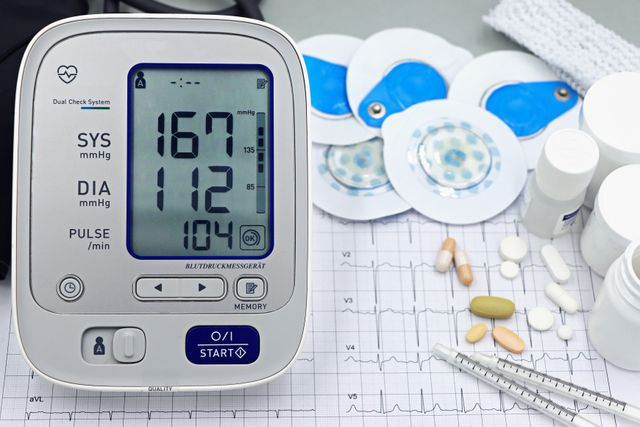
High Blood Pressure: What the Numbers Really Mean
A doctor explains what blood pressure numbers mean, how to measure yours properly at home, why US and European guidelines disagree, and what really lowers it.

See a doctor promptly if
- A reading of 180/120 mmHg or higher with chest pain, breathlessness, weakness on one side, slurred speech, confusion or sudden visual change. This is an emergency
- Blood pressure of 140/90 mmHg or higher in pregnancy, especially with headache, upper abdominal pain, visual disturbance or sudden swelling
- A repeated reading of 180/120 mmHg or higher even without symptoms. This needs same-day medical assessment
- New severe headache, nosebleeds that will not stop, or breathlessness lying flat alongside high readings
- Blood in the urine, or a sharp fall in how much urine you pass, together with high readings
What your blood pressure reading means
| Result | In short | What it means |
|---|---|---|
| Under 120/80 | Normal | Normal. Recheck every year or two unless a doctor has asked for more. |
| 120-129 over under 80 | Elevated | Elevated, not hypertension. It is the band where habits still do the work: salt, weight, alcohol, movement and sleep. |
| 130/80 | Stage 1 | Stage 1 hypertension by the American thresholds, and elevated by the British ones. Either way it is a home-reading and lifestyle conversation before it is a medicine one. |
| 140/90 | Stage 2 | Yes, on any guideline in the world. It is the number at which treatment is discussed almost everywhere. One reading is not a diagnosis, so take an average over a week of home readings before deciding anything. |
| 141/91 to 149/95 | Stage 2 | Not dangerous today, but consistently above the treatment line. Bring a week of home readings to an appointment rather than a single number. |
| 150/100 | Clearly high | Above the line by a clear margin. Not an emergency without symptoms, and it does need an appointment rather than watching. Recheck sitting quietly, arm supported, after five minutes rest. |
| 160/100 to 179/119 | High, act soon | Not an emergency by itself, and it should not wait weeks. Book within days, and sooner with headache, chest discomfort, breathlessness or visual change. |
| 180/120 or above | Urgent | Recheck once after five minutes rest. If it stays there with chest pain, breathlessness, weakness, trouble speaking, severe headache or visual change, that is an emergency now. Without symptoms, it is a same-day appointment. |
One result is a snapshot. Ranges differ a little between labs, and what a number means depends on the rest of you. Check it against the guidelines.
The short version
- Blood pressure only means something as an average of many careful readings. One number taken in a rushed clinic room is not enough.
- Home readings run lower than clinic readings. So 135/85 mmHg at home is treated the same as 140/90 mmHg in clinic.
- Some guidelines label 130/80 mmHg and above as hypertension. Others still use 140/90 mmHg. The disagreement is about labels, not about who benefits from treatment.
- Lifestyle change is not a token gesture. Less salt, more potassium, regular aerobic exercise and weight change each move systolic pressure by about 4 to 8 mmHg. They add up.
- High blood pressure almost never causes symptoms. That is exactly why it damages arteries quietly for years.
Check your blood pressure1 min, free, nothing to install
Almost nobody feels high blood pressure. That is the whole problem with it. It is a number that predicts strokes, heart attacks, kidney failure and dementia decades in advance. It gives you no warning at all while it does its work. So the number has to do the job that symptoms would normally do. That means it is worth understanding properly rather than glancing at once a year.
What blood pressure actually is#
Every time the heart contracts, it pushes a volume of blood into a closed system of tubes. The pressure inside those tubes depends on two things: how much blood is being pushed, and how much the tubes resist it.
That is the entire mechanism, and it explains almost everything else. Anything that increases the volume in the system, extra salt holding extra water, kidneys that retain sodium, hormones like aldosterone, raises pressure. Anything that narrows or stiffens the tubes, age, smoking, sympathetic nervous system drive, the renin-angiotensin system, also raises pressure. Most people with high blood pressure have a bit of both.
With age, the elastic layer in large arteries is gradually replaced by stiffer collagen. A stiff pipe cannot cushion the surge of each heartbeat, so the peak pressure climbs. This is why systolic pressure tends to rise through life while diastolic pressure often plateaus or falls after the fifties.
What the two numbers mean#
The top number, systolic, is the peak pressure during the heartbeat. The bottom number, diastolic, is the resting pressure between beats. Both are measured in millimeters of mercury, written mmHg.
A useful rule of thumb: under roughly age 50, the diastolic number carries more risk information. Over 50, systolic dominates. The gap between them, the pulse pressure, widens as arteries stiffen. A pulse pressure above about 60 mmHg in an older adult is itself a marker of arterial aging.
The thresholds, and why the US and Europe disagree#
This is the part that confuses people. It is worth being honest about: the disagreement is about where to put the word "hypertension", not about what harms arteries. Risk rises continuously from around 115/75 mmHg upwards. There is no biological cliff edge. Guidelines simply draw a line somewhere useful.
| Category | US (ACC/AHA) | Europe (ESC 2024) | UK (NICE) |
|---|---|---|---|
| Ideal / not elevated | Below 120/80 | Below 120/70 | Below 120/80 |
| In between | Elevated: 120-129 systolic and below 80 diastolic | Elevated BP: 120-139 systolic or 70-89 diastolic | : |
| Stage 1 hypertension | 130-139 or 80-89 | . (falls under "elevated BP") | Clinic 140/90 or above, home average 135/85 or above |
| Hypertension | 130/80 or above | 140/90 or above | 140/90 or above |
| Stage 2 / severe | 140/90 or above | . | Clinic 160/100 or above, home average 150/95 or above |
| Crisis range | Above 180/120 | 180/110 or above | 180/120 or above |
The 2017 US guideline moved the hypertension label down to 130/80 mmHg, which overnight reclassified tens of millions of people. The argument for it: risk is already measurably higher there, and the label prompts action. The argument against it: most of those people are advised on lifestyle rather than medication anyway, and labeling healthy people as diseased has costs: insurance, anxiety, over-treatment.
The 2024 European guideline took a middle path. It created a category called "elevated blood pressure" spanning 120-139 systolic or 70-89 diastolic, kept the hypertension diagnosis at 140/90 mmHg, and, importantly, recommended treating most people towards a systolic target of 120-129 mmHg once treatment is started. So Europe reaches a similar destination by a different route.
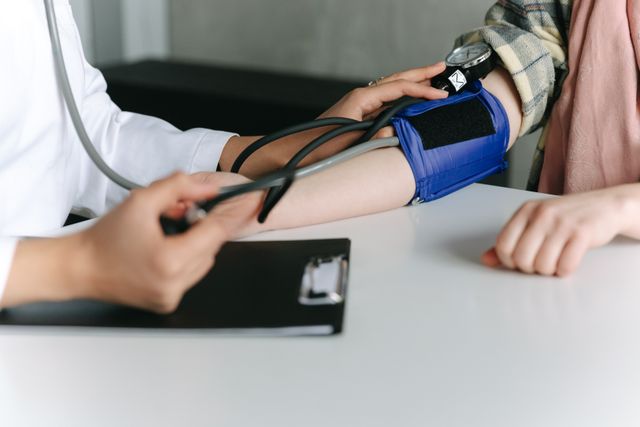
How to measure blood pressure at home properly#
Most home readings are wrong, and they are wrong in predictable ways. A badly taken reading can be 10 to 25 mmHg off. Enough to start medication that was never needed, or to miss disease that was. This is the single highest-value thing in this whole subject, and almost nobody is taught it.
Before you sit down#
- Use a validated upper-arm cuff, not a wrist or finger device. Wrist devices are extremely position-sensitive. Validated device lists are published by STRIDE BP, the British and Irish Hypertension Society and the AHA.
- Check the cuff size against your arm. A cuff that is too small over-reads, sometimes badly. The bladder inside should wrap around roughly 80 percent of your arm circumference. If you have a large upper arm, you almost certainly need a large cuff.
- No caffeine, smoking, food or exercise for 30 minutes beforehand.
- Empty your bladder. A full bladder adds around 10 mmHg.
The position#
- Sit in a chair with a back, feet flat on the floor, legs uncrossed. Crossed legs add 2 to 8 mmHg.
- Rest the arm on a table so the cuff is at the level of your heart. An unsupported arm held up adds up to 10 mmHg.
- Put the cuff on bare skin, not over a sleeve, with the lower edge about 2 cm above the elbow crease.
- Sit quietly for five minutes first. Not scrolling, not talking. Talking during a reading adds up to 15 mmHg.
The readings themselves#
Take two or three readings one minute apart, and record all of them. The first is usually the highest. Many devices will average for you.
For a diagnosis or a treatment decision, one session is not enough. The standard protocol is seven consecutive days, morning and evening. Morning readings before medication and before breakfast. Evening readings before dinner. Then discard the entire first day and average everything else. That average is what actually means something.
Home averages run lower than clinic readings, so the thresholds shift: a home average of 135/85 mmHg is treated as equivalent to a clinic 140/90 mmHg, and 150/95 mmHg at home is equivalent to clinic 160/100 mmHg.
White coat and masked hypertension#
Roughly one in five people with high clinic readings has white coat hypertension. Really normal pressure everywhere except a medical setting. It is not imaginary and not entirely harmless, but it usually does not need medication.
The mirror image matters more. Masked hypertension means normal clinic readings and high readings at home or on 24-hour monitoring. It carries a cardiovascular risk similar to sustained hypertension and it is, by definition, invisible in clinic. It is more common in men, smokers, people who drink heavily, night shift workers and people with diabetes or kidney disease. This is the strongest argument for measuring at home even if your clinic numbers look fine.
What causes it#
In about nine out of ten adults there is no single cause. This is called primary hypertension, and it is the accumulated result of genetics, age, salt intake, body composition, alcohol, inactivity, poor sleep and chronic stress.
The remaining one in ten has a specific driver worth finding, especially if pressure is high at a young age, suddenly worsens, or does not respond to three medicines:
- Obstructive sleep apnea. By far the most common and most missed. Snoring, witnessed pauses in breathing, daytime sleepiness.
- Primary aldosteronism. An adrenal cause, present in perhaps 5 to 10 percent of people with hypertension and far more in resistant cases. Often with a low potassium level.
- Kidney disease or narrowing of the renal arteries.
- Thyroid disease, and rarely phaeochromocytoma or Cushing's syndrome.
- Medicines and substances: regular anti-inflammatory painkillers, decongestants, some hormonal contraceptives, steroids, licorice, stimulants, and some herbal preparations sold for energy or weight.
What your doctor will check, and why#
The tests are not looking for the cause so much as for damage already done and other risks stacked alongside.
| Test | What it is looking for |
|---|---|
| Urine albumin-to-creatinine ratio | Early kidney damage, often the first organ to show it |
| Creatinine and eGFR | Kidney function |
| Sodium and potassium | Clues to adrenal causes. A baseline before treatment |
| HbA1c and lipid panel | The other risks that multiply with blood pressure |
| ECG | Thickened heart muscle from years of pressure load |
| Eye examination | Changes in the retinal vessels mirror those elsewhere |
What actually lowers blood pressure, in real mmHg#
These are approximate average systolic reductions from controlled trials, in people who already have raised pressure. Effects are smaller in people with normal pressure, and they are not perfectly additive, but they do stack meaningfully.
| Change | Typical systolic drop |
|---|---|
| DASH-style eating pattern (vegetables, fruit, pulses, nuts, low-fat dairy, less processed meat) | 5-11 mmHg |
| Reducing sodium towards 1.5-2 g a day | 5-6 mmHg |
| Increasing dietary potassium (fruit, vegetables, pulses) | 4-5 mmHg |
| Aerobic exercise, 90-150 minutes a week | 5-8 mmHg |
| Dynamic resistance training, 2-3 sessions a week | 4-5 mmHg |
| Isometric exercise, such as wall sits or handgrip holds | 4-8 mmHg |
| Weight change, per kilogram lost | roughly 1 mmHg |
| Cutting heavy alcohol intake to moderate | 4 mmHg |
Two things stand out. First, the diet effects are as large as a low dose of a single medicine. Second, potassium is the underrated one. Most people are told to cut salt and never told to add potassium, and the two work through the same kidney mechanism.
What is oversold#
Garlic tablets, beetroot shots, celery seed extract and hibiscus tea all have small trials behind them showing drops of 2 to 5 mmHg, usually short-term and in small numbers. They are not harmful in food amounts, and they are also not a substitute for the things above. Magnesium and fish oil have modest, inconsistent effects. Anything promising to "cure" hypertension or let you stop medication is selling something.
Home devices that measure from the wrist or that are not on a validation list are worse than no device, because they generate confident wrong numbers.
What I see in clinic#
The single most common thing I correct is not diet and not medication. It is technique. Someone arrives worried, holding a phone with three readings taken while sitting on the edge of a bed, arm dangling, straight after climbing stairs, cuff over a shirt. We repeat it properly and the number drops fifteen points.
The second most common is the person who feels fine, so stops treatment, and comes back two years later with a thickened heart muscle on the ECG. There is no symptom that tells you your arteries are under strain. That absence is not reassurance.
And the question I am asked most is whether stress causes it. Acute stress raises pressure for minutes. Chronic stress raises it through what it does to sleep, alcohol, activity and eating. Both are real, but the second one is where the treatable part lives.
At work#
Occupational health data makes this obvious in a way clinic data does not.
Shift work is independently associated with higher blood pressure and blunted overnight dipping. Normally pressure falls 10 to 20 percent during sleep, and losing that dip predicts cardiovascular events. If you work nights, your morning-and-evening home schedule should follow your own sleep-wake cycle rather than the clock.
Chronic noise exposure above roughly 80 dB is associated with higher blood pressure through sustained sympathetic activation, independent of hearing loss. Hearing protection is a blood pressure intervention as well as an ear one.
Heat stress does the opposite acutely, it dilates vessels and drops pressure, but repeated dehydration is hard on kidneys, and kidney injury feeds back into hypertension over years.
Workplace medicals are also where masked hypertension gets caught, because they measure people who feel perfectly well and would never have booked an appointment.
When to get help now#
Go to an emergency department if a reading of 180/120 mmHg or higher comes with chest pain, breathlessness, one-sided weakness, slurred speech, confusion, sudden visual change or a severe sudden headache. That combination suggests active organ damage rather than just a high number.
Seek same-day advice for a repeated reading of 180/120 mmHg or higher without symptoms, and for any reading of 140/90 mmHg or higher in pregnancy, especially with headache, visual disturbance, pain under the ribs on the right, or sudden swelling of face and hands.
Book a routine appointment if your seven-day home average is 135/85 mmHg or above, if readings are climbing over months, or if you snore heavily and wake unrefreshed.
The bottom line#
Blood pressure is an average, not an event, and the way you measure it matters as much as what you do about it. Buy a validated upper-arm cuff, learn the technique, and bring seven days of readings rather than one frightening number.
The guideline disagreement between the US and Europe changes the label on your result far more than it changes what should be done about it. And lifestyle change here is not a consolation prize. Done together, salt, potassium, movement and sleep move the number by as much as a starting medicine does.
Check a blood pressure reading now
Type the two numbers from your monitor.
If you are buying a monitor
Get an upper-arm cuff, not a wrist one, from a validated brand like Omron. Expect $30 to $60. Check the cuff size fits your arm; a too-small cuff reads high.
Buying through this link supports the free library with a small commission. It never changes a pick.
Have your own result?
Send the report. A doctor explains every value in writing within 3 days.
Look up another result
A result is rarely the only one on the page. Each of these gives the bands, in both unit systems, and what happens next.
- Health age result6 bands
- How late is late?6 bands
- How long it usually lasts, by cause5 bands
- How to tell how dehydrated you are5 bands
- Is this a fever?8 bands
- LDL result5 bands
- MCV number3 bands
- Median grip strength after 50, by age and sex8 bands
- Morning readings, and what to do with them6 bands
- Platelet count6 bands
- Potassium result6 bands
- Prolactin result6 bands
- PSA result7 bands
- Reading after a meal5 bands
Common questions
What is a normal blood pressure?
Which number matters more, the top or the bottom?
My reading is high at the clinic but normal at home. Which is right?
Can I lower blood pressure without medication?
How much salt is too much?
Does drinking water or lemon water lower blood pressure?
Do I have to take blood pressure tablets forever?
People also ask
Not what you were looking for?
Say what you came for and we will take you there.