Exercise With Knee Pain: Why Rest Is Not the Answer
A doctor explains why rest makes most knee pain worse, why quad and hip strength is the real treatment, how to load a sore knee safely, and when to get checked.

See a doctor promptly if
- A hot, red, very swollen knee with fever or feeling unwell
- A knee that locks, blocks part way, or gives way and drops you
- Rapid swelling within an hour of a twist or a fall
- Morning stiffness lasting over an hour, in several joints, with swelling
- Pain, swelling or warmth in one calf, especially after surgery or a long trip
- Knee pain that is worse at rest and at night, with weight loss or fever
The short version
- Rest helps for a few days after an injury. After that it weakens the thigh and prolongs the pain.
- Strengthening the quadriceps and hip muscles is the main treatment for most long term knee pain.
- Exercise is first line treatment for knee osteoarthritis, ahead of painkillers, injections and surgery.
- Some pain during exercise is acceptable. It should settle to your usual level within 24 hours.
Check your movementone walk, free, nothing to install

Almost everyone with a sore knee gets the same advice. Rest it. That is right for a few days after an injury, and wrong for nearly everything after that.
What rest actually does to a knee#
Pain makes a knee go quiet, and the thigh muscle starts to shrink within days. Measurable loss of quadriceps size can happen inside a week of not using it.
A weaker thigh means the joint absorbs more of every step. More load on a sensitive joint means more pain. More pain means less movement, and the loop tightens.
Cartilage has its own reason to dislike rest. It has no blood supply. It feeds on joint fluid pushed in and out as the knee bends. A knee that does not move is poorly fed.
Rest is a tool for the first two or three days after a clear injury. After that it stops being treatment.
The muscles that treat a knee are not in the knee#
Two muscle groups protect the knee joint, and both of them sit above it.
The quadriceps, at the front of the thigh, control how fast the knee bends. They work every time you land, sit down, or step down a stair. When they are weak, the joint surfaces take the shock instead.
The hip muscles, mainly the gluteals on the side of the hip, steady the thigh bone. When they are weak, the knee drifts inward with each step. That tilts the kneecap in its groove and loads one side of the joint harder.
This is why the exercises that help most can look like they are aimed at the wrong place.
Sorting out the common patterns#
Knee pain is not one problem. The pattern tells you a lot before any scan does.
Pain around or behind the kneecap is the most common pattern in adults under about 50. It builds slowly rather than starting suddenly. It is worse going down stairs, squatting, kneeling, and after sitting still for a long time. The classic clue is a knee that aches after a long drive or a film.
Pain on the inside of the knee becomes more common with age. It is the usual site of knee osteoarthritis, because the inner half of the joint carries more load. Meniscal problems sit here too, often with a tender line along the joint.
Stairs down versus stairs up is a useful question. Going down loads the kneecap joint hardest, so kneecap pain and osteoarthritis complain more on the way down. Going up asks more of strength, so weakness shows up there instead.
Morning stiffness has a clock. Osteoarthritis stiffness loosens within about 30 minutes of moving. Stiffness that lasts over an hour, in several joints, with swelling and warmth, points at inflammatory arthritis. That is a different condition with different treatment, so name it to a doctor.
| What you notice | Common pattern | Usual first move |
|---|---|---|
| Ache around the kneecap, worse on stairs down and after sitting | Kneecap (patellofemoral) pain | Quadriceps and hip strengthening, less deep squatting for now |
| Inner knee pain and stiffness under 30 minutes each morning | Knee osteoarthritis | Graded strength and walking, load the joint on purpose |
| Locking, catching, or giving way | Meniscal tear or a loose fragment | Get assessed rather than train through it |
| Stiff for over an hour, several joints, swollen and warm | Inflammatory arthritis | See a doctor, blood tests are the next step |
| Hot, red, very swollen knee with fever | Possible joint infection | Same day emergency assessment |
What knee osteoarthritis actually is#
Osteoarthritis gets described as a joint wearing out like a tire. That picture is wrong, and it makes people move less.
Osteoarthritis is a change across the whole joint. Cartilage thins and softens, the bone underneath thickens, small bony ridges form at the edges, and the lining becomes mildly inflamed. The joint is remodeling, not counting down a mileage limit.
Two useful facts follow. X-ray changes and pain match each other poorly, so a report of moderate degenerative change does not set your future. The joint also responds to load, so loading it well is a way of treating it.
Exercise is first line treatment for knee osteoarthritis in every major guideline. It sits ahead of painkillers, ahead of injections and ahead of surgery. It is not a risk to be managed carefully. It is the treatment.
Strength work and aerobic work both help. The effect on pain is similar in size to common anti inflammatory painkillers, without the stomach and kidney trade offs. Our comparison of common painkillers covers those trade offs.
Does running ruin your knees#
The belief that running wears knees out is widespread. The evidence points the other way.
Studies comparing recreational runners with inactive people find less knee arthritis in the runners. Elite athletes running very high mileage for many years do show higher rates, which is a different exposure from a few runs a week.
Cartilage behaves like other tissue. Regular moderate loading keeps it healthy. Long term unloading does not.
The strongest predictor of knee arthritis is a previous serious injury, such as a torn ligament or a meniscal tear that needed surgery. Body weight and joint shape matter too. Recreational mileage barely registers next to those.
Running with existing knee osteoarthritis is often fine. Build slowly and use the pain rules below.
How to load a painful knee#
These are the rules that make the whole thing workable, and most people are never told them.
- Pain during exercise up to about 4 out of 10 is acceptable.
- Pain should settle back to your usual level within 24 hours.
- Pain should not climb week after week.
If all three hold, keep going. If they do not, reduce the load rather than stopping. You can shorten the range of movement, cut the reps, slow down, drop the weight, or hold a position instead of moving through it.
A reasonable starting set, two or three times a week:
- Sit to stand from a chair, without using your hands if you can.
- Wall sits, held 30 to 45 seconds, repeated five times.
- Step ups onto a low step, around 4 to 6 inches (10 to 15 cm).
- Side lying hip raises, or side steps with a band around the thighs.
- Calf raises, holding a counter for balance.
Add a little each week. Judge the program at six to twelve weeks, not at one.
Our strength training guide covers sets and progression, and exercise over 60 covers starting from a low base. Ready made routines are there if you want the decisions made for you.
Getting through a flare#
A flare is a few days to a couple of weeks of extra pain and swelling. Flares happen even in a program that is working.
- Do not drop to zero. Cut the load by roughly half instead.
- Move the knee through its range every day, even gently.
- Isometric holds, where the muscle works without the joint moving, are usually tolerated when moving hurts.
- Ice suits a hot, swollen feeling. Heat suits a stiff one. Use whichever helps you move.
- An over the counter painkiller for a few days is reasonable if it keeps you walking. Ask a pharmacist first if you take other medicines or have stomach, kidney or heart conditions.
- Build back over one to two weeks, not in one session.
Weight, said plainly#
The knee carries about three to four times body weight during ordinary walking, and more on stairs. That multiplier is why small changes in body weight are felt so strongly at the knee.
A change of 10 lb (4.5 kg) removes roughly 30 to 40 lb (14 to 18 kg) of load per step. Across a day of walking, that adds up.
None of this is a moral point. It is mechanics, and it is one lever among several.
Weight loss and exercise together improve knee pain more than either does alone. Exercise also improves knee pain when weight does not change. So the movement does not have to wait for the scale. Our guide to waist size and BMI explains which measure is more useful to follow.
The knee problems that are not a training problem#
Strengthening is the answer for most knee pain. It is not the answer for these.
- A knee that locks or blocks part way through its range, or gives way and drops you. That suggests a torn meniscus or a loose fragment inside the joint.
- A hot, red, very swollen knee with fever. Joint infection is uncommon and it is an emergency.
- Rapid swelling within an hour of a twist or fall. That usually means bleeding inside the joint, often from a torn ligament.
- Morning stiffness over an hour in several joints, with swelling. This points at inflammatory arthritis and needs blood tests.
- Pain that is worse at rest and at night, unrelated to activity, especially with weight loss or fever.
- Pain, swelling or warmth in one calf. Swelling in one leg needs same day assessment for a clot.
Knee pain can also be referred from the hip. If moving the hip reproduces the knee pain, the hip is the place to look.
What I see most in clinic#
The question I am asked most is whether exercising a painful knee wears it out faster. It does not. The knee that gets used is usually the knee that hurts less a year later.
Two patterns come up again and again. The first is someone handed an exercise sheet who does it for eight days, feels no change, and decides it failed. Eight days is not a trial of anything.
The second is someone who stopped walking to protect the knee. Six months later the knee is stiffer, the thigh is thinner and the pain is worse. They did exactly what they were told.
I also meet people frightened by the word arthritis on a report. The report describes the joint today. It does not describe how you will be moving in five years.
At work#
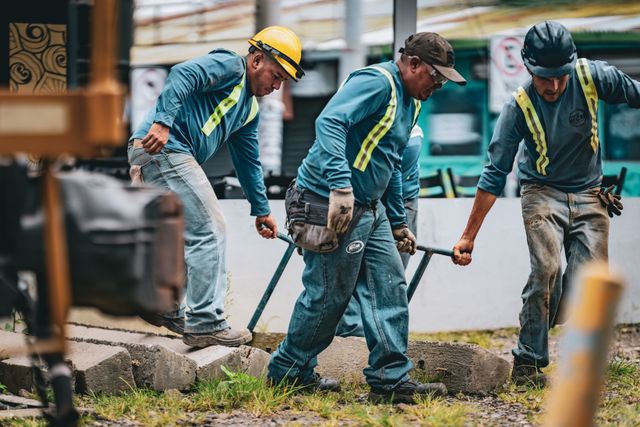
Kneeling work brings its own knee problem. Floor layers, tilers, roofers and plumbers spend hours on hard surfaces. That compresses the small cushion in front of the kneecap, which can swell and turn tender.
Knee pads with gel or foam, a kneeling mat, and standing up every 20 to 30 minutes all help. So does changing which knee takes the load.
Standing all day on concrete is the other pattern. Cushioned matting, supportive footwear and a footrest to shift weight all help. Long periods of sitting need the same answer, regular change of position.
When to get help#
Book a routine appointment if knee pain has lasted more than six weeks, or is stopping you doing normal things. Book if it has not shifted after eight weeks of strengthening, or if the knee swells repeatedly.
Get seen the same day for any of the following:
- A hot, red, swollen knee with fever.
- A knee that locks or gives way and drops you.
- Rapid swelling after an injury.
- Pain, swelling or warmth in one calf.
The bottom line#
Rest fixes almost no long term knee pain, and it costs you thigh muscle within days. For most people the treatment is boring and effective. Strengthen the quadriceps and hips, load the joint on purpose, and allow six to twelve weeks. Knee osteoarthritis is not a wearing out process, and exercise is its first line treatment rather than a risk. Some pain during exercise is fine, as long as it settles within a day and does not climb week on week.
Should this go to a doctor?
Three honest answers, a plain answer back.
Not magic, just convenient
Useful when your plan calls for more protein than your meals reach, especially for older adults protecting muscle. Whey or a plant blend both work; unflavored mixes into anything.
Buying through this link supports the free library with a small commission. It never changes a pick.
A question about your own situation?
One question, answered personally by a doctor in writing within 24 hours.
Common questions
Should I rest my knee or exercise it?
Is it bad to exercise when my knee hurts?
Does running cause knee arthritis?
What are the best exercises for knee pain?
Why does my knee hurt more going down stairs than up?
Will losing weight help my knee pain?
How long does knee pain take to improve with exercise?
People also ask
Not what you were looking for?
Say what you came for and we will take you there.